No workshop agenda survives contact with reality
Why planning a workshop like a waterfall project never works, and how being more agile helps you get to the right outcomes.

If you’ve got an important workshop coming up, the temptation is to plan out every five-minute slot, create lots of slides and write detailed instructions for every activity. It gives you and your stakeholders the reassuring sense that everything is in hand.
But there’s a paradox with workshop planning: the more meticulously you plan, the more brittle it becomes.
I saw this in a recent three-day workshop for a stakeholder who was anxious about it going well and therefore wanted every session to be tightly defined. We spent hours creating hundreds of slides, planning everything to the nth degree.
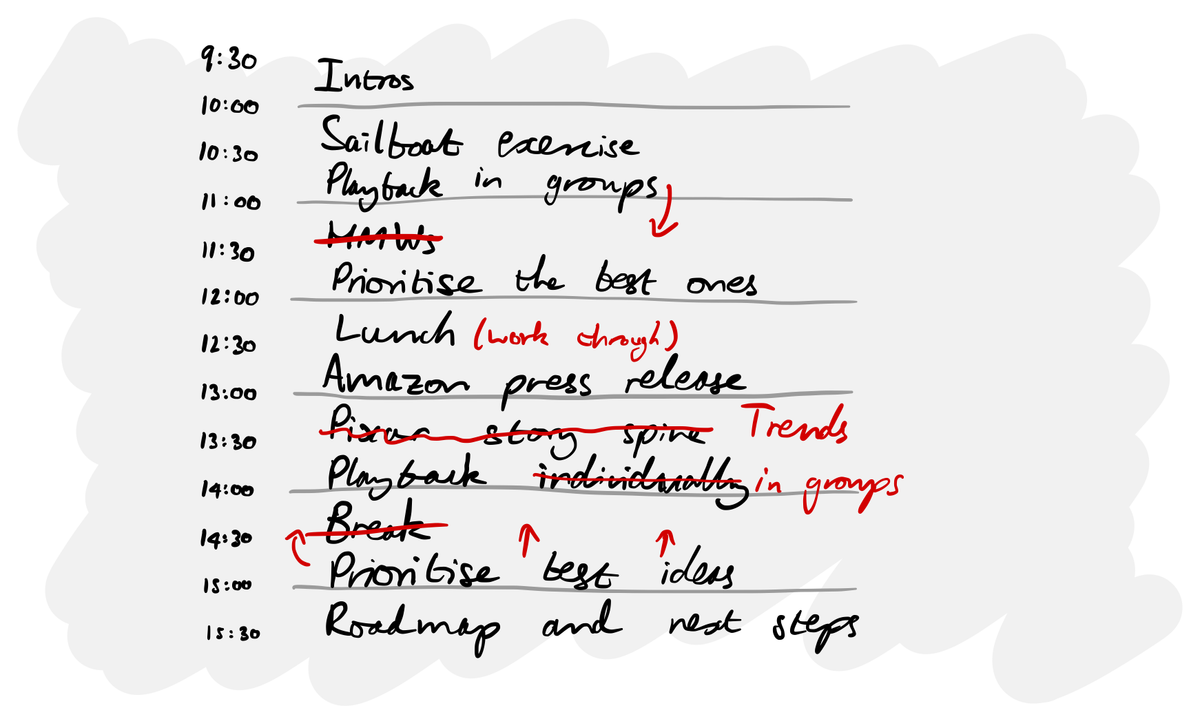
Of course, what actually happened is that the agenda completely changed during the workshop. We adapted to the topics that emerged, adjusted the timings and some of the content we’d laboriously prepared was never used at all.
Why workshops resist rigid plans
You can’t predict how a group of people (who you may never have met or worked with) will behave. Will they grasp something quickly? Will they need more time? How will they respond to a particular task?
Workshops are about exploring a topic and reaching some kind of consensus. You go through cycles of divergent and convergent thinking, and you can’t always predict what will be discovered. Sometimes what you find will mean you have to make changes to the workshop. And sometimes the consensus won’t align with your expectations, which can render the exercises you’d planned completely irrelevant.
The best insights tend to come from unscripted moments: challenging discussions, disagreements and conversations that don’t fit neatly into a pre-prepared canvas. When people come together, especially in person, that’s when ideas should spark. But if you’re rigidly following a plan, you risk suffocating any spontaneous moments.
Plan like it’s agile, not waterfall
When you develop software using waterfall, you define everything upfront and estimate how long each task will take. We all know that this never works in practice, and yet that’s how we plan most workshops.
Maybe a better way to think about running a workshop is like a more modern, agile project. You’re focused on the outcomes rather than stressing about following a time plan. You have a backlog of activities, some more important than others. You can be flexible with the order, and you can swap things in and out as needed.
Running a workshop in a more agile way means you need more content and activities than you have time for, so you have options. To do this, you’ll need to build a personal toolkit of tried and tested methods over time. Books like Gamestorming are a good starting point, but you’ll develop your best material through experience: activities that you know work and that you can pull out when the situation calls for it.
Facilitate like a conductor, not a playwright
Workshops are much more like improv comedy than a scripted play. In a play, you say the same lines regardless of how the audience reacts. In improv, you respond to what’s actually happening.
It’s the same principle as when you conduct research: your discussion guide is a framework, not a script, and you adapt based on what’s actually being said. Facilitation works the same way. Your role is to guide the group towards the desired outcome, not to execute a plan.
I did a workshop recently with my longtime collaborator (and all-round legend) Tim Loo that was the opposite of an over-planned client workshop. There were almost no slides, just the agenda and activities prepared in advance. We had a timeline on a Miro board with the activities and outcomes we wanted, but as the workshop progressed we adjusted the plan: adding things, removing things, changing the order, shortening and lengthening activities.
Workshop participants don’t pay too much attention to whether you’re on track or not, and it’s better to manage people’s creativity and energy than to stick to a rigid time plan.
Making flexibility work in practice
You still need a plan. Stakeholders need the confidence that you know what you’re doing and that there’s a structure to the workshop. You won’t get sign-off if it seems like you’re making it up as you go along. The trick is to treat the plan as a hypothesis, not a script. Present it as your best prediction of how the time will be used, while communicating that you expect the agenda to evolve as the workshop progresses.
Being flexible doesn’t mean being unprepared either. If anything, it means you’re more prepared. I ran a training session recently where we asked people at the start what they wanted to learn. One thing that came up was trends, which we hadn’t prepared any content for. Instead of sticking to the plan, we added a talk and slotted it in later. That’s only possible if you have a selection of content and activities ready to deploy beyond what’s on the original agenda.
A few tips for making this work:
- Focus on the objective, not the agenda. The goal is to meet the outcome of the workshop, not to follow the predefined plan. Keep that in the front of your mind and let everything else flex around it.
- Co-facilitate if you can. This is significantly easier with two people. One can present while the other watches the time plan and thinks about what and how to adjust it.
- Experience builds confidence. The more workshops you run, the looser you can be with the agenda because you trust your toolkit and your instincts. If it’s your first workshop, plan more tightly. Over time, you’ll learn to hold plans more loosely.
Upfront planning makes us feel safe and prepared, but the willingness to abandon the original agenda and be flexible is what makes workshops actually achieve their outcomes.